
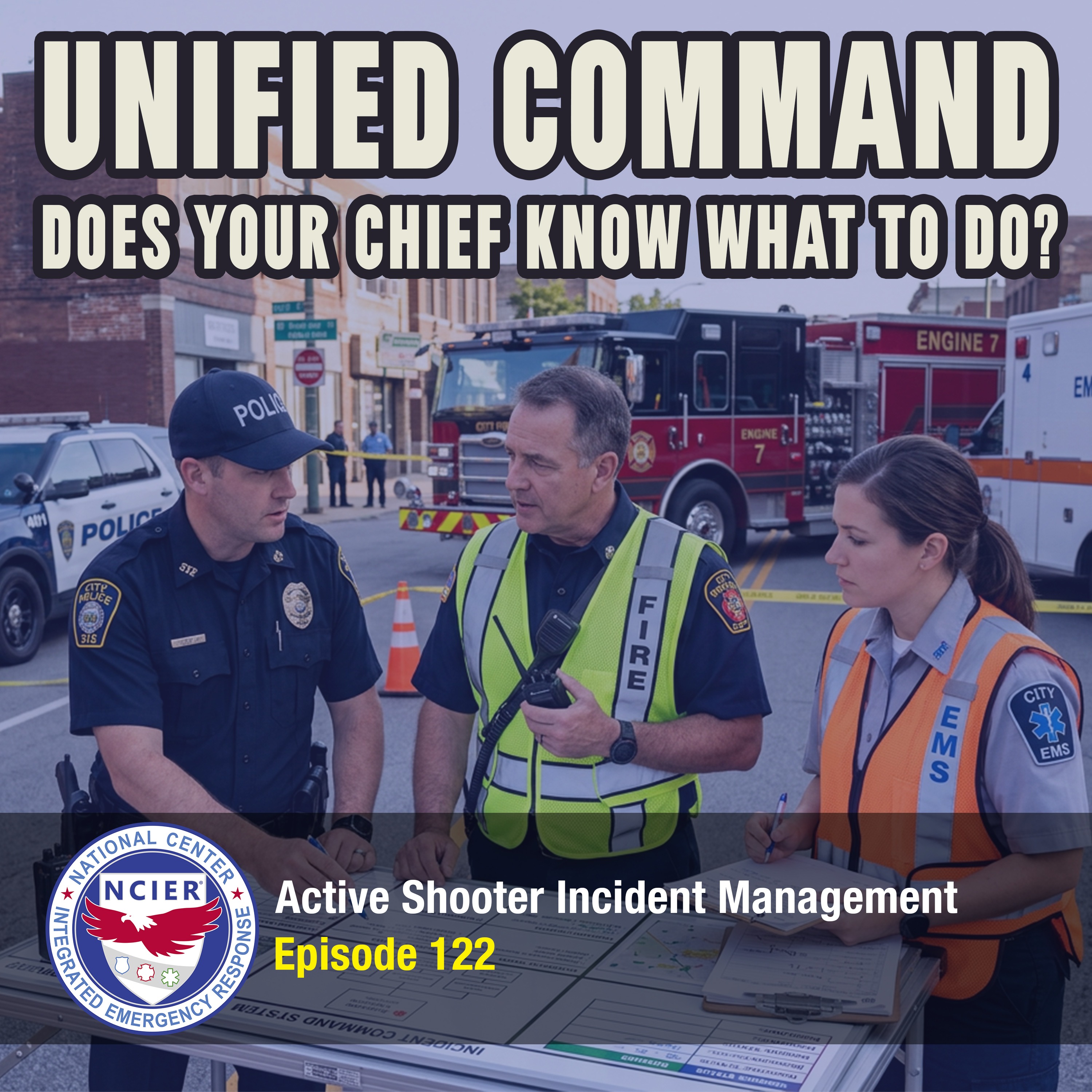
Ep 58: ASIM Model Policy
Episode 58
Published Nov 6, 2023
Last updated Feb 18, 2026
Duration: 38:18
Episode Summary
In this week's podcast, we discuss the development of a model response policy and the obstacles organizations may face when trying to implement it.
Episode Notes
Adam Pendley, Mark Rhame, Don Tuten, and Bill Godfrey discuss the Active Shooter Incident Management model policy (available for free download from the C3 Pathways website) along with common implementation challenges and trying to get multiple agencies on board. You do not want to miss this conversation.
Download the ASIM Model Policy as an MS Word document from https://c3.cm/policy
View this episode on YouTube at https://www.youtube.com/watch?v=maYTj8maOJM
Transcript
Bill Godfrey:Welcome to the Active Shooter Incident Management Podcast. My name is Bill Godfrey, your podcast host. I am being rejoined by Adam Pendley, Mark Rhame, and Don Tuten today. Welcome back, guys.
Adam Pendley:
Thank you.
Don Tuten:
Thank you.
Adam Pendley:
It's awesome.
Bill Godfrey:
So we have actually come back in today to follow up on a podcast that we had, I don't remember when it was, I think it was a couple of weeks ago, to talk about a model response policy. Interestingly, we've recently been talking a lot about what are the challenges to implementation in an organization. And one of the things that we heard is it would be really nice to have a model policy, a go by policy, which we've had one for a while, but we've made it available on our website. So we're going to talk a little bit today about what should go into a model policy that fits and how not to fall into some of the traps that we've all seen.
So Karla, if you want to take us over to the screen, I'm going to kind of show for those of you that are watching on YouTube, and if you go to our website at c3pathways.com. And for those of you that are listening to audio only, it's just c3pathways.com, and under the navigation for resources, down in the bottom left under documents is policy, and that is actually there as a Word document so that you have the ability to edit the format or change some of the language if you feel like you need to. So a general order jointly expresses the commander's intent for response active shooters, what it says right down there in policy, and I'm going to toggle over here to pull it up.
So our model policy, as you guys are well aware, but for the audience, it's only three pages. It's three pages, and it's a joint policy for law enforcement, fire-EMS. So the police chief, fire chief, EMS chief, emergency manager, the sheriff, whoever, they all sign one piece of paper and then that piece of paper gets copied and put into everybody's book, which is anachronism because we all have to have our own policies. We'll talk about that. But right here at the very top, this is written in the military style of the five paragraph order for commander's intent. And so right here in the very first paragraph, it expresses that this is the commander's intent, but it gives responders the authorization to deviate from this policy if they determine that that's appropriate, necessary, in the best interest. There's no way that you can have a policy that's going to accommodate every single threat. And so it's important to say responders, you have the authority to deviate from this.
The very beginning is the orientation, which kind of establishes some of the basic data and stats, very much surmised so that if somebody's first exposure to training is this, they're getting the basics down and dirty, what they needed. In the situation down here, we're talking about the perpetrators and the percentages there, daylight hours, single perpetrator, 97% of the time, et cetera. A little quick thing to remind everybody about friendly forces being on scene. Section three is the mission, and this is where we recap our priorities. So basically, active threat, rescue and then clear are three priorities and then followed up by your public messaging, reunification, investigation, recovery. Your concept of operations, which lists out the details and the objectives that you're trying to accomplish. But basically this paragraph is the meat, and if you notice that it's fairly short because it says it incorporates the Active Shooter Incident Management Checklist by reference. And that's one of the ways that we achieve just a simple three-page policy is by incorporating a process that's already well established and very mature.
The tasks, where to start on the checklist, your timeline, it sets 20 minutes as the goal for the transport of all injured off the scene. And your four major benchmarks, threat is neutralized or no direct threat is readily apparent, your rescue task forces are deployed, your ambulance exchange point is secured, injured or transported or in the process of being transported. It talks about movement and then crosscheck logistics, which is essentially remember to open the EOC, command and single, which is a fancy way of talking about the radio. Note, that all law enforcement is on one channel, all fire-EMS on another channel. But there are a couple of notes down here. The functions that are easy to split off, the transport operation is easy to split off, perimeter is easy to split and intel may want to split. And that's it. That's the sum total of the three pages of this policy, which again is up on the website. So with that, guys, let's take some time and talk about, let's start with why is it important to have a joint policy that's literally a single page policy?
Don Tuten:
Yeah, right off the bat, it puts everybody on the same page. Just like you said, it puts everybody on the same mission, it puts everybody on the same goals, it puts everybody on the same parameters that was established by the three or four or five or however many you have leaders of each one of the organizations. So there is no question mark of what are we doing, what are they doing, everybody is consistent with the same policy and hopefully that translates into training together as well.
Bill Godfrey:
Yeah. And Mark, what are some of the things that can go wrong when law enforcement has its policy? And they may have all sat in the room and jointly done it, maybe, if they're lucky. But what's the problem with everybody having a separate policy?
Mark Rhame:
Well, you can look at a lot of case studies after action reports that show that responses that were siloed. I mean, literally they didn't put a command post integrator response in a command post. They didn't have an integrator response in regard to their tactical and having a triage and a transport officer standing next to each other with their game plan being one and the same. Basically, right after the threat has been neutralized or held in place, it's going to eat up the clock. We're not going to be organized. We're not going to get our teams together. We're not going to do exactly what we need to do to save lives. And if we're not on the same page, we don't have same policy, that's going to be our problem.
Bill Godfrey:
And Adam, I'm going to take you back down memory lane here. I'm wondering if you remember this.
Adam Pendley:
Okay.
Bill Godfrey:
Because we did not talk about this before we jumped on the air. So this is over a decade ago, and I can't remember if it was the first time I met you or it was the second time, we were doing some joint training at your agency, that shall remain nameless, and we were doing an active shooter scenario. And law enforcement got to the part where you had a warm zone established and you were in the command post and you turned to your fire-EMS counterpart and you said, "Okay, I'm ready for your teams to move up."
Adam Pendley:
Right.
Bill Godfrey:
Do you remember this?
Adam Pendley:
Yeah, absolutely.
Bill Godfrey:
Do you want to tell everybody what happened?
Adam Pendley:
Well, I mean, again, there was kind of a lack of understanding between the two of us of what that even meant, ready for the teams to move up and to where and how to get there and all of those sort of things. So again, kind of coming back to why a joint policy is so important is we need to be speaking the same language when it comes to what a rescue task force is and when they can move up and so on and so forth. And to kind of extend on what Mark was saying is that when we do, we talk about after action reports a lot, never to second guess what another agency may or may not have done.
Bill Godfrey:
Exactly.
Adam Pendley:
But in the sense of you can identify certain things that we can avoid next time. Communications is always one. Oftentimes, an over convergence of resources and staging or lack of staging is another one. But often, you'll see policies that have gotten in the way of response because things that sound good when maybe you're lucky in the same room and you're writing it down that maybe fire and EMS can't move forward until the suspect is captured, killed or contained. You'll sometimes see that in a policy. Well, the reality is that kind of loses the fact that sometimes the suspect has fled.
Don Tuten:
I think Adam gave you the political answer of-
Bill Godfrey:
He did. He skipped over the really good part.
Don Tuten:
Yeah.
Bill Godfrey:
That's all right. I wasn't going to let him get away with it. I was going to come back to it. So since Adam clearly is not going to tell on himself, but Don, you're laughing so hard, your face is red.
Don Tuten:
Yeah.
Bill Godfrey:
So there was a, shall we say a discussion, Don, is that the right? A brief back and forth.
Don Tuten:
A brief, yeah.
Bill Godfrey:
Between Adam and the fire rescue person about whether or not the fire department actually participated in warm zone operations at the time.
Don Tuten:
Right.
Bill Godfrey:
Again, just for the audience, this was a long time ago.
Don Tuten:
Sure, yeah.
Bill Godfrey:
This was more than 10 years ago. And Adam insisted that they do warm zone operations and the fire battalion chief insisted that they do not do warm zone operations. And we got past it, they worked it out. But afterwards, as soon as we got on break, Adam goes and grabs his SOP book and the fire battalion chief grabs his SOP book and the two of them compared notes. And literally, the sheriff's office policy said dire department does warm zone operations and the fire department policy says...
Adam Pendley:
Something different.
Bill Godfrey:
Yeah, we wait for an all clear before we go down.
Don Tuten:
Yep.
Adam Pendley:
But the interesting thing about that is that was some number of years ago.
Bill Godfrey:
It was.
Adam Pendley:
And I'm proud of fire departments across the country, they are now just as eager to get inside and save lives as law enforcement is.
Bill Godfrey:
Sure.
Adam Pendley:
So all the more reason to make sure that you have a joint policy. So we're working well together. And because to your point earlier, Bill, there was no practical reason why we needed to go get two different standard operating procedures to see if we were on the same page. That's kind of crazy.
Don Tuten:
And you're training to the same standards.
Bill Godfrey:
Right.
Adam Pendley:
Yeah.
Don Tuten:
No matter what agency, you're training to the same standards and promotional exams or based off the same information.
Bill Godfrey:
Yeah.
Don Tuten:
Hopefully by the time people start making rank and they start moving up in the promotional side, whichever entity that they're on, they have the same operational knowledge of what their policy says.
Mark Rhame:
Yeah, a little side note, Bill, just did a recent class, very, very large metropolitan area and something I've never seen before. They actually had their policies and practices that fire-EMS actually responded into a hot zone. Never seen that before.
Bill Godfrey:
Oh, that's interesting.
Mark Rhame:
So when we brought up that discussion during the class, we said, "No, no, no, that's a warm zone environment. Warm or cold for fire-EMS." And they go, "Nope, our policy is totally the opposite. We deploy into a hot zone, doesn't matter if the active threat's still going on, we deploy." And we're going, "That's a regional approach?" And they go, "Absolutely." So when we talk about these policies, they need to be a regional concept, not just an inner city, inner county concept because we're going to rely on others. Others are going to come to it.
Bill Godfrey:
Yeah. So let's tangent and talk about that a little bit. So I think we've made the case of why it needs to be literally one piece of paper that everybody signs off on, but let's talk a little bit about the importance of including your neighbors. If you're a county, including the municipalities, the municipality, the other municipalities of the county and the area around you. Mark, you alluded to this a little bit, but what are some of the challenges that can occur when, I mean, you do a joint policy and you get everybody in your city, the city police, city fire, city EMS, all on the same page, city dispatch, comm center, you're all on the same page, and that's great for the city.
Mark Rhame:
Yeah.
Bill Godfrey:
Then what?
Mark Rhame:
And then you get on a scene where you ask for mutual aid first response, they come in and they go, "We don't do that. That's not our policy." And on the scene is not a time to have that discussion. That is the wrong time. You got to have those agreements and discussions upfront, know your partners, know what they're going to do. And in the ideal situation, again, is to have regional policies in regard to this. I mean, on the fire-EMS side, one of the places I worked at, we had a high-rise area and we knew that it was going to be a mutual aid response on a significant high-rise event. That has to be a regional approach. You can't get on a scene, get into arguments and some people say, "Well, I'm not doing that." Because it doesn't work.
Don Tuten:
Yeah. And if you're not on the same page, you're useless. You've come to the fight with no weapons in hand, and other than handing out roadmaps and orange juice to somebody, you're not doing any good.
Bill Godfrey:
Yeah, it's funny. Mark, you just kind of made me think of something I hadn't thought of in a while, but a number of years ago, we were on the EMS side trying to get a regional protocol established across five counties. And you can imagine how difficult that was trying to get everybody on the same page. And we kind of found a novel way to deal with it that allowed everybody to maintain their identity, but allowed us to get on a common page. And basically, we split into a two column format. So the main content took up two thirds of the page and then over there was a little column to the side. And so that if Mark said, "Well, I'm not doing it that way," then there was a note that says, "Mark doesn't do it this way" or "Bill and Don don't do it this way. We do this instead."
And what was agreed upon is that the most aggressive procedure would be the standard in the paragraph, and then everybody would've to take exception to that if their medical director didn't want to give them to them. And I'm wondering, that might be an interesting way to get one started because here's what happened. The first year we did it, we had 140, 150 exceptions, which was a lot. The second year, we were down to about a dozen. By the third year, we did it, nobody took an exception to anything, everybody was on the same page. And so sometimes you got to play the long game on this stuff. But that might be an interesting, Adam, we were just talking about this before we got started, that we've got a checklist update coming and we'll update a couple of things on this policy. That might be an interesting formatting change, is to kind of set that aside.
Adam Pendley:
Well, I mean at a minimum, this provides the starting point for a great conversation about how you might adapt your policies locally. Again, using this as a model policy, it clearly paints the picture, provides priorities, gives a starting point. I love that it provides a target time to get everyone transported because at the end of the day, that's what we're fighting against is time to save those lives. So it gives you a benchmark for that. And these are just clearly benchmarks that then allow, right at the start it says that the responders are empowered to exercise judgment initiative and improvisation to solve the problem. So some additional policies or training may come into play from some of these follow on agencies. That's okay. But here's our priorities, this is what we're going to focus on in my place America to make sure that we're saving lives. Right?
So that's the starting point of the conversation. And one of the other things that I think makes this a model policy is you're avoiding going down very granular details, step-by-step sort of things. From a law enforcement perspective, it may be necessary to spell out very specific procedures on what you do with someone who's being detained for DUI. Right? That requires a certain number of steps and there has to be testing to the jail and it has to be really detailed.
Bill Godfrey:
Yeah. Legal considerations.
Adam Pendley:
But those are more routine situations where you'd have time to actually review the policy. These are high stress, not very frequent events.
Bill Godfrey:
Fast moving.
Adam Pendley:
Fast moving, that you have to focus on clear priorities, clear lines of effort, and that's it. And again, like I mentioned earlier, sometimes policies paint agencies into a corner that they never realize was going to happen. And sometimes when we teach this in local jurisdictions, almost every law enforcement agency in the country has a policy that says that you will not fire warning shots, that are under no circumstances you are allowed to fire a warning shot. However, in an act of assailant event, you may need to fire some rounds in a distraction sort of way or in some way to kind of draw the gunman away from the innocents and back to where they can focus on the response and stop killing people. Right? So where does that fit?
Bill Godfrey:
Don, you were a law enforcement boss for a long time and had a whole lot of responsibility over policies and procedures and you've seen it go well and seen it go wrong. How important is it? And then Mark, I'm going to come back to you for the same thing as a former fire chief, how important is it to actually put in writing what Adam pointed out? Is that you are giving empowerment and authority to the people that work for you to exercise their own independent judgment, initiative and improvisation even though you've written out what you want them to do.
Don Tuten:
Yeah. So in my agency that I was with, it was a large agency, excuse me, we had that exact same thing for every one of our policies. Now, I'll just give you a case in point. One of the policies we had is you'll never provide a precision and mobilization technique on a high vehicle or on any vehicle going more than 55 miles per hour. One of the cases that comes to my mind off the top of my head is we had somebody at a high rate of speed in the opposite lane of traffic running cars off the road. It was literally a life and death situation. And I gave the order for them to violate policy to, it's common sense. So all of our policies are written to where they're a general guideline, and I hate to say it like this, but mainly policies are in place because people have screwed up in the past.
Bill Godfrey:
Yeah.
Don Tuten:
That's reality of stuff. But moreover is policies are there to show this is our general response to what we do every day. There are going to be items out there that, "Hey, I need you to pit that vehicle" or "I need you to insert here." "Well, I'm not trained or I'm not this," but life safety overrides a few words on a piece of paper right now. And if I can justify that and I can show why the safety of the public at large is more important than words on a piece of paper and you can dictate that, then you're good to go.
Mark Rhame:
And I don't believe one size fits all. So frankly, and even when we talk about structures or places we're responding to, going to a 7/11 is going to be so much different than a campus, school campus, or a mall or a multi-story residential or a commercial building. So you have to have flexibility, you have to. And if you have an event that goes from a single shooter to multiple shooters or multiple sites, you have to have that flexibility to deal with those. So by putting it in guidelines, so it gives the incident commander some flexibility based upon that incident, allows them to be successful instead of working in something that says, "I got to do this first. I got to do this next. I got to do this next."
Don Tuten:
And your knowledge of the event and your personal knowledge of, you may take somebody, any policy may be written for the brand new supervisor or for the brand new officer. The reality is it doesn't take into effect the relationships you've built, the experience that you have, the different types of calls that you've done that's been similar to something and what has worked in the past that maybe policy hadn't caught up with either. That's another big piece of it, is a lot of times rewriting policy, "Oh yeah, that's a great idea. You rewrite it." "I'll get to it when I get to it."
Bill Godfrey:
Oh, yeah.
Don Tuten:
Or whoever's in charge of that. So it's one of those things where, and this policy being the model policy is so wide scope. I mean, look at the mission alone. There's three primaries and then the fourth on the public messaging that's open-ended to say, "Okay, these are our objectives. How are you going to accomplish those objectives?" But as long as you meet the objective, then it's back on the person obviously performing their job.
Adam Pendley:
Absolutely.
Bill Godfrey:
Yeah. It's funny you mentioned policies usually get created when people screw up. Mark and I used to joke when he and I worked together all the time, wouldn't it be fun to have the SOPs named after the person that caused it to exist?
Don Tuten:
I think we've probably all had one or two that's probably been named after us in the past.
Bill Godfrey:
Yeah-
Adam Pendley:
It's kind amazing the policy books start out like this.
Mark Rhame:
And I say for the people who are listening, maybe it's a half inch, inch big and now they're like in two three inch binders of all the policies.
Don Tuten:
Right, they're all electronic. They don't even print them out anymore.
Mark Rhame:
Yeah.
Adam Pendley:
Oh my God.
Don Tuten:
But we all know the names.
Adam Pendley:
Right.
Mark Rhame:
Right.
Adam Pendley:
That's true. That is true.
Bill Godfrey:
Yeah, if institutional memory goes long enough.
Adam Pendley:
Yeah.
Bill Godfrey:
All right, so I think the model policy provide some good examples of what should be in there. Let's talk about, and Adam mentioned this earlier, the granularity and staying away from that. What are some of the common things that you guys have seen that come up that really should not be in the policy or shouldn't be locked down tight or things like that? Who wants to lead off with that one?
Mark Rhame:
Like an older traditional fire-EMS departments, they're still in this mode of we're not going in until it's cleared. We're not going in. And if you put that in.
Bill Godfrey:
Yeah. And what does clear mean? How did they even define it?
Mark Rhame:
Yeah. They're just waiting on some law enforcement officer to come up and say, "Okay, you have permission to come in now." And I see that more I guess from a fire-EMS standpoint that they've been traditionalists, they're a older department, this is just the way we've done it forever and ever and ever, and we're not willing to change.
Don Tuten:
You will always arrive at upwind. Well, can you arrive from upwind? I don't know. That's what our policy says to do, but you'll carry this type of shield or you'll carry this type of weapon in. And those are agency specific guidelines that does not cross the board. And it gets people once again down in those weeds of specifics that really don't need to be there.
Adam Pendley:
Well, anything that involves numbers. So what Mark said about the traditional approach, many years ago we taught the five diamond formation. And that may not be, well, it's not even really trained anymore, but that wouldn't necessarily be practical. But in the same way, trying to specifically number the formation of your rescue task forces really comes to mind from an example that Don and I were both involved in where the first in rescue task force on an active shooter event was an ad hoc team of an on-duty sergeant and a ladder company that happened to be doing training right next door to where the incident occurred. And they formed a rescue task force with one sergeant and the crew from a ladder company, and they went inside shortly after the act, there was no more active threat. So when you try to define that too specifically, that might not have been allowed. And then you have someone questioning in their mind and they're slowing down their response because they're questioning in their mind whether it's okay to go in with something that's different than what the policy says.
Bill Godfrey:
Yeah, Adam, it's interesting you mentioned that. I actually think that's the most common one I see that I always try to counsel people not to do that. So there's so many policies where they have dictated in writing what an RTF is. It's two of this, it's three of that, it's four of this. I know one major metropolitan agency that dictates in writing that at RTF will be five law enforcement and seven fire and EMS personnel.
Adam Pendley:
That's amazing.
Bill Godfrey:
12 people. And I'm like, "That's not an RTF, that's a column."
Adam Pendley:
Right.
Bill Godfrey:
But you need neither here or there. But here's the bigger problem. And Mark, you talked about this on one of the, I think the last time we were together on the podcast, the first RTF team that goes down range should be traveling small and light.
Mark Rhame:
Yep. Clean and mean.
Bill Godfrey:
Clean and mean. They don't know what they're walking into.
Mark Rhame:
Yep.
Bill Godfrey:
But the second RTF, the third RTF that goes through the door 10 minutes later and there's not been gunfire for 15 minutes or we've got a suspect in custody or whatever, fill in the blank, that RTF might be two officers and two, three engine companies carrying backboards and stretchers and extra medical supplies and equipment. And that's perfectly fine.
Mark Rhame:
Yep.
Bill Godfrey:
You got to let the circumstances kind of dictate what you want to do.
Don Tuten:
That first RTF is gathering intelligence.
Bill Godfrey:
Yes.
Mark Rhame:
Am I needed and do I need help?
Bill Godfrey:
Right.
Mark Rhame:
And-
Bill Godfrey:
And what kind of help and how many do I need?
Mark Rhame:
Yep.
Bill Godfrey:
If you've got two reds and 12 greens, that's one thing. But if you've got 12 reds and two greens, that is a game changer in terms of what you need for resources and equipment
Mark Rhame:
In the class, we talk about maybe Trojan horse in that fourth or fifth RTF, you can put them five, six fire-EMS person in the back of a rescue unit with backboards and scoops and other tools to be successful. And you wouldn't do that in the first RTF. You wouldn't do that. And if you put that in writing, you put it in concrete, it ain't going to work.
Bill Godfrey:
Yeah.
Mark Rhame:
Because you don't know if you're going to do that or not.
Bill Godfrey:
It's got to be dynamic.
Mark Rhame:
Yeah, it has to be.
Bill Godfrey:
And just to expound upon that, I want to make that clear what Mark is talking about. So you've got a couple of RTFs that have deployed down range, whatever their staffing may be. You've got extra EMS personnel. Maybe you're a little short on law enforcement personnel, you don't have enough, but they're ready to call in for an ambulance. You've got an ambulance exchange point that's secured, put five, six, seven, eight people, firefighter, EMS personnel in the back of the ambulance with the extra equipment and use it literally as a Trojan horse or a bus.
Mark Rhame:
Yeah.
Bill Godfrey:
When it pulls up into the secured ambulance exchange point, those people can get out when that first RTF comes out with the patient or the second RTF or whoever is, when that rescue task force comes out with the patient, they get the patient loaded and then the extra personnel can all plus that team up and go back. And this is just ways of getting around the resources that you're dealt. Here's the other example, and Adam, maybe you could talk a little bit about this. You and Don both came from a large metro area. You literally had urban, suburban and rural in your jurisdiction.
Adam Pendley:
Yep.
Bill Godfrey:
And now I've seen some of the staffing levels you do in the urban area. I know what typically the staffing levels are in the suburban and I know some of the response times in the urban area, I mean, the rural area really stretch out.
Adam Pendley:
Right.
Bill Godfrey:
You've got one agency, one agency, and yet you could have three very different responses. Can you guys talk a little bit about how that can impact?
Adam Pendley:
Well, sure. And we talk about this a lot, even when we talk about the fifth man concept, it's a fifth man concept. It's not always a hard number.
Bill Godfrey:
Right.
Adam Pendley:
In other words, if you're in a rural area and you have two officers that have gone in as that first contact team, it may be the third officer that has to stay and become tactical to help guide the follow on resources. Whereas if you're in a resource rich area, an urban area where you have multiple officers on duty, you may have seven or eight inside before somebody takes up the mantle of being the fifth man or becoming the tactical group supervisor.
So again, anything that involves trying to pin you down to a specific number or a specific moment in time where you will do X, Y and Z, I think just paints you into a corner because all of these incidents are dynamic. Another one that came to mind just as we were talking is again, from some well-meaning guidance, oftentimes fire department policies paint all active shooter events as a mass casualty incident. And the reality is is that potentially slows down the response because then that has the chief going to his mass casualty event policy and he's laying out tarps and doing some other things. And again, I'm way outside my lane, my Holiday Inn Express card has expired.
Bill Godfrey:
No, you're right. You're right on the money.
Adam Pendley:
Yeah.
Bill Godfrey:
The example that I always use when I talk about this because you don't run that many mass casualty incidents anymore and it's just different today than it was before. But the example I always use is do you have a medical helicopter? When you have a bad trauma event, do you call a helicopter? In most places, they're either in an area where they do or they're familiar with the procedures. And I always use the example of, "Okay, you're in a really big hurry because this is a bad trauma call. We got to get the patient to the surgeon." So the helicopter lands and 60, 90 seconds later, the helicopter's off the scene with the patient. And everybody's always looking at me in the classroom, and they start looking at each other and they look back at me and they're shaking their head no. The helicopter's on the ground 10 to 15 minutes while the medics are playing 20 questions with you, transferring equipment. And the whole time you're looking at your watch going, what are we doing?
Adam Pendley:
Yeah.
Bill Godfrey:
We called a multimillion dollar helicopter because we were in a hurry and now we just pissed away 15 minutes. It's the exact same thing in an active shooter event if you go into mass casualty mode and the only thing you had was three people shot.
Don Tuten:
Well, the other piece of that, and building on what both of you guys said, is 80% of the agencies in the area within the United States, roughly 80%, are those smaller agencies. They don't have a lot of resources to throw at things. So you may only have five officers on duty during that time. Maybe let's just say even 10, a decent size, 10 officers on duty, it dictates, and you may have one fire station within that jurisdiction. So mutual aid is coming in right off the bat.
Bill Godfrey:
Sure.
Don Tuten:
So your initial response is going to be everything that you can do with those two or three people or six people that are on duty as well as that one fire station that comes in. And maybe they're not a full functioning fire station. Maybe they do combat and then rescue is separate. So if you get too far in the weeds, you've hampered your response without saying, "Okay, we need to modify this for our area, for our community, and we need to," and Mark alluded on it also, "coordinate with our outside responses so everybody is on the same page when they come in."
Bill Godfrey:
I think that's a really good point. And I also do want to remind people, I mean we're talking about a model policy that's three pages long, but it does incorporate the checklist, and that's a big, big, big component of the process, if you will. And so it's incumbent upon them not only to train the policy, but to train the checklist and to practice it. And we've always talked before about the importance of integrating everybody together. And boy, that holds true in training. Fire departments shouldn't be doing any kind of actor shooter training where they haven't involved law enforcement and vice versa. Even if it's simple contact teamwork, fire department should be there with them.
Adam Pendley:
Yep, I agree.
Bill Godfrey:
To participate in the training. And the dispatch should be included. So as we come up on our 30 minutes here and we move to wrap up, what are some of the things that you guys, let's go around with, what are some things that you'd like to see in a policy? So let's say for example, there's some people that just politically, they can't get it done, they can't get everybody on one page for whatever reason. What are some good things that you guys want hit on to make sure that say is or shouldn't be in policy? Adam, let's start with you.
Adam Pendley:
Well, as I mentioned earlier, I do like the ability to exercise initiative and good judgment. I think that should be clear in every policy. But one of the things that jumps out at me early on is a policy that kind of paints the typical situation. They're all different, but the statistics really do paint a picture. And as one of our other instructors often says when we're discussing the painting the picture is that when you look at 97% of the time it's a single attacker, very rarely is body armor involved, very rarely is IEDs involved, it's often a certain type of weapon and so on and so forth, is that you're not fighting al-Qaeda. This is not necessarily always going to be a massive gunfight. You are fighting a doofus who woke up in his mother's basement this morning and decided that today was the day he's going to do his terrible act. So painting that picture reminds everyone that the training that you've done, being disciplined, focusing on the priorities will get the job done.
Don Tuten:
Yeah.
Bill Godfrey:
Mark, how about you?
Mark Rhame:
Yeah, I got to echo that. I like the flexibility, the capability for the incident commander to be able to modify based upon what they're getting exposed to. I do like that the policy shows what our priorities are. I mean, priority's always going to be that threat. You got to take out that threat. You can't really move on to the next step if the threat's in your way. If they're standing right in your face, you got to take them down, remove them from the equation. And it really gives you from an A to B, A to C, all that sort of thought process of how to accomplish this goal and getting all your priorities done.
Don Tuten:
Yeah, no, and there again, I'll say it a little bit different way. Each one of these policies, what make them great is what are your objectives? What are the objectives to meet this policy or the title of this policy? In this case, this act of attack. The second piece of that is, what do I need to do to fulfill those objectives? And it's very plainly written out here is here are our objectives, this is what we need to do to meet that objective. Period in. Have a nice day. The rest of it is listen, within your training experience and things that you have within your agency to make this go away, now make it go happen.
Bill Godfrey:
These are all great examples. In fact, leaves me struggling a little bit to come up with one, but I think what I would add in is watch out because you guys hit the real high points, I mean we talked about the important point of it being joint and all that kind of stuff. What I would say is watch out for your definitions.
Don Tuten:
Yeah.
Bill Godfrey:
The words we use matter. And one of you alluded to this earlier, right at the beginning of the podcast, the phrase killed, captured, contained. There is an example that we talk about. There was a large incident, metro area, and they had done a lot of training. They had done a tremendous amount of training, but it was a hot zone. The definition of a hot zone is until the suspect is killed, capture or contained. And it's a great soundbite. Killed, capture, contained. What it doesn't account for is the killing stopped and we don't know why. The suspect has been subdued. The suspect killed themselves, which they do 26% of the time, 27% of the time. They fled the scene, which happens on a regular basis. They were subdued by the very people they were attacking. They're hiding somewhere, waiting to be caught, but they're not killing anymore. And because of that definition, they ran into an issue where the rescue task forces were dressed out, begging to deploy, and the incident commander said no because it was still a hot zone by their definition.
Don Tuten:
Yep.
Bill Godfrey:
And so I would just caution everybody to really don't over define things, think them through, make sure that you're working with subject matter experts in the area that can throw some what if and challenges at you. Give it to people and tell them to tear it up, rip it apart, show me where the holes are, show me where the vulnerabilities are. I mean, that's exactly how we did this with our team. It took us, I want to say it was about four months of batting this around among the instructors before we finally got to something we felt pretty comfortable with. So don't be afraid of participative comments and watch out for your terminology and how you define things. All right, well as we wrap up, any closing thoughts? Adam?
Adam Pendley:
The one other word that's in here that I really like is crosschecking. So oftentimes, your first person that's in charge of a position might be neck deep in trying to focus on what's going on and somebody standing there who does have an opportunity to crosscheck what's on the checklist and make sure we didn't miss anything is another great feature of this policy.
Bill Godfrey:
And just so the audience can kind of follow along, here's crosschecking. I show up as the fire-EMS guy to tactical and I'm supposed to be the triage, but Adam is tactical and he is in the weeds and he is not ready for me to do anything with RTFs yet. I've got a list. I've got the tactical checklist in front of me. Did you assume command?
Adam Pendley:
Yes.
Bill Godfrey:
Have you set staging location?
Adam Pendley:
Yes.
Bill Godfrey:
Have you called for the additional resources?
Adam Pendley:
I'm doing that now.
Bill Godfrey:
You got more contact teams where you need them?
Adam Pendley:
Yes.
Bill Godfrey:
That's a crosscheck.
Adam Pendley:
Yep.
Bill Godfrey:
That's it. So we can all help each other out. I think that's a great one, Adam. Mark?
Adam Pendley:
Puts people on the same page. Right?
Bill Godfrey:
It does, it does. Mark, how about you? Final thoughts?
Mark Rhame:
If you don't have a policy, you need to have a policy. I mean, in regard to this gives a good sample you can start with. No plan is not a plan, by the way. So in a lot of the places we go to and teach and they say, "Well, we're working on that. We don't have a plan," this is a good starting point.
Bill Godfrey:
Very good. Don, final thoughts?
Don Tuten:
Yeah. No, just buy in with all the major players within your jurisdiction is key and it starts on the lowest level. And if you don't start now, it'll never happen. So get to work.
Bill Godfrey:
Amen. Amen. And I think my final thought, tagging on to what you just said, Don, you can try to legislate it from on high and eventually you'll get it done. It's a lot easier if you just get everybody into training together.
Don Tuten:
Yep.
Bill Godfrey:
All kinds of problems, all kinds of problems that come up in our day-to-day lives of things, you put people in training together and let them get to know each other and things just have a way of working themselves out.
Don Tuten:
Absolutely.
Bill Godfrey:
Well gentlemen, thank you guys for coming in and talking about those. And for those of us that are following us on the audio only podcast, we will put the download link for this sample policy in the show notes. And for those of you watching on YouTube, we'll also put it in the notes there. I'd like to thank our producer, Carla Torres. As always, please do subscribe if you're not already subscribing to the podcast. If you're watching us on YouTube, subscribe to it there. Share this with the people that you work with, with the other agencies around you. This isn't going to work if we don't spread the word and get everybody on the same page. And with that, until next time, stay safe. Thank you, guys.