
NCIER®
Infographics Published February 25, 2026

The 911 Intelligence Nexus: The Backbone of Hostile Event Management

Executive Summary

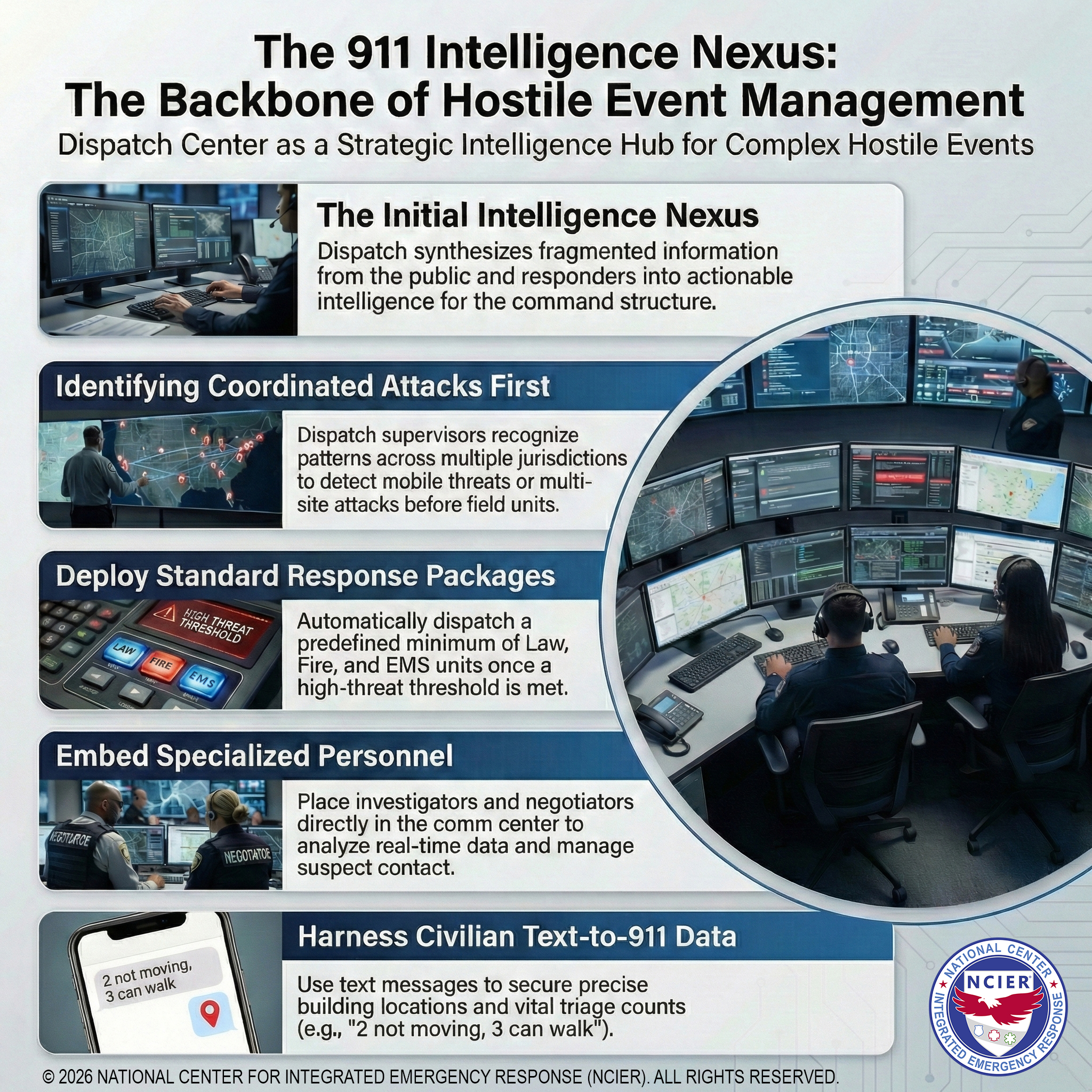
"The infographic, titled "The 911 Intelligence Nexus," illustrates the critical role of dispatch centers during hostile events. Its primary purpose is to outline how the dispatch center acts as the initial intelligence nexus, synthesizing chaotic, fragmented information into actionable intelligence for the incident command structure. The visual highlights key operational strategies, including the early identification of coordinated attacks , the automatic deployment of standard response packages to prevent inadequate resource allocation , and the strategic embedding of specialized personnel like investigators and negotiators directly within the communication center. Furthermore, it emphasizes leveraging modern communication tools, specifically civilian text-to-911 data, to gather precise building locations and critical triage counts. Ultimately, the infographic conveys that the dispatch center's information management forms the foundational backbone of effective incident response."

Key Takeaways

  • Dispatch synthesizes chaotic, fragmented information into actionable intelligence for responders.
  • Dispatch centers often recognize coordinated, multi-site attacks before field units do.
  • Automatically dispatch predefined minimum unit responses for high-threat threshold calls.
  • Place trained negotiators and investigators directly within the dispatch communication center.
  • Use civilian text messages to relay precise locations and triage counts.

DOWNLOAD INFOGRAPHIC (JPG)

Infographic: The 911 Intelligence Nexus


This infographic depicts findings in the NCIER® research white paper The Critical Role of Dispatch and 911 in Hostile Event Management. Details about the report, including excutive summary, key takeaways, full text, and FAQs may be found on the report information page.
Frequently Asked Questions

The dispatch center acts as the initial intelligence nexus. It processes, verifies, and disseminates critical information flowing from the public and initial responders to the incident command structure. By synthesizing chaotic and fragmented information, it provides actionable intelligence that is critical to the outcome of the incident.
During multi-site or fast-moving attacks, dispatch supervisors have a broader view of incoming calls across a jurisdiction. This allows them to hear multiple reports and recognize patterns, giving them the first opportunity to piece together that seemingly chaotic events are actually connected.
Relying on a standard response package avoids an inadequate initial response to a hostile event. Instead of creating chaos by dispatching everyone available, a predefined minimum number of law enforcement, fire, and EMS units are automatically dispatched once a high-threat threshold is reached.
Civilians on the scene serve as a crucial intelligence source and can use text-to-911 to relay vital information. These simple text messages can provide responders with precise locations within a building, the number of uninjured survivors, and basic triage counts of the injured (such as those who can walk versus those who cannot move).
Integrating specialized personnel into the communication center enhances incident response capabilities. Placing a trained negotiator in the center allows them to feed intelligence to the dispatcher communicating with a suspect without abruptly changing the speaker. Embedding an investigator allows for real-time analysis of incoming 911 calls and tips, which helps the intelligence team develop a clearer picture of the unfolding event.
Communication issues are a recurring challenge noted in after-action reports. Common technical and procedural hurdles include inconsistent channel naming across agencies, improper distribution of encryption keys, and a failure to train on shared disaster channels.

Top

Find the Perfect Training Class For You